


May 11
What is Early Onset Muscle Weakness Syndrome / Calf Recumbency?
Early Onset Muscle Weakness Syndrome is a newly discovered genetic condition in Holsteins that can result in affected calves being unable to stand.
What do we know?
This unfavorable genetic condition was discovered based on research done at Penn State University, in collaboration with other researchers. This collaboration, which included ABS Global, used sequence data to discover the likely causative mutation in the CACNA1S gene on chromosome 16 (Dechow et al., 2022). It appears to be a recent mutation within a very common Holstein haplotype. More will be learned about the frequency and impact as the industry gathers more information. For more information, please read a joint statement from CDCB, Holstein Association USA, and NAAB.
Jersey cattle found to carry the JH1 haplotype have a defective version of a gene called CWC15 which is important for cells to be able to process signals from other genes. This gene is associated with infertility. It is estimated that up to 25% of Australian Jersey herds carry the JH1 gene.
Haplotypes like MW and JH1 have been discovered due to the development of genomics. A Haplotype is a set of closely linked genetic markers or DNA variations on a chromosome that tend to be inherited together.
What do we know about carrier animals?
Jersey cattle found to carry the JH1 haplotype have a defective version of a gene called CWC15 which is important for cells to be able to process signals from other genes. This gene is associated with infertility. It is estimated that up to 25% of Australian Jersey herds carry the JH1 gene.
Haplotypes like Muscle Weakness and JH1 have been discovered due to the development of genomics. A Haplotype is a set of closely linked genetic markers or DNA variations on a chromosome that tend to be inherited together.
What does that mean for our farmers?
When speaking with local farmers here in Australia, the farmers have explained that calves affected by the Muscle Weakness are born healthy, with support they feed and after investing much time in the animal, they never manage to stand up and unfortunately need to be put down. This can be both traumatic and stressful to both the animal and farmer during an already busy time of the year for Dairy Farmers.
The JH1 Haplotype is known to cause infertility, an embryo inheriting a defective version of CWC15 from both its sire and dam is simply unable to complete its development and instead dies during gestation. There are no living animals with two copies of the defective gene. This has a major impact on a herd’s fertility performance.
What are the next steps?
The industry acknowledges that these defects must be addressed quickly. A gene test was developed to determine definitively which animals are carriers.
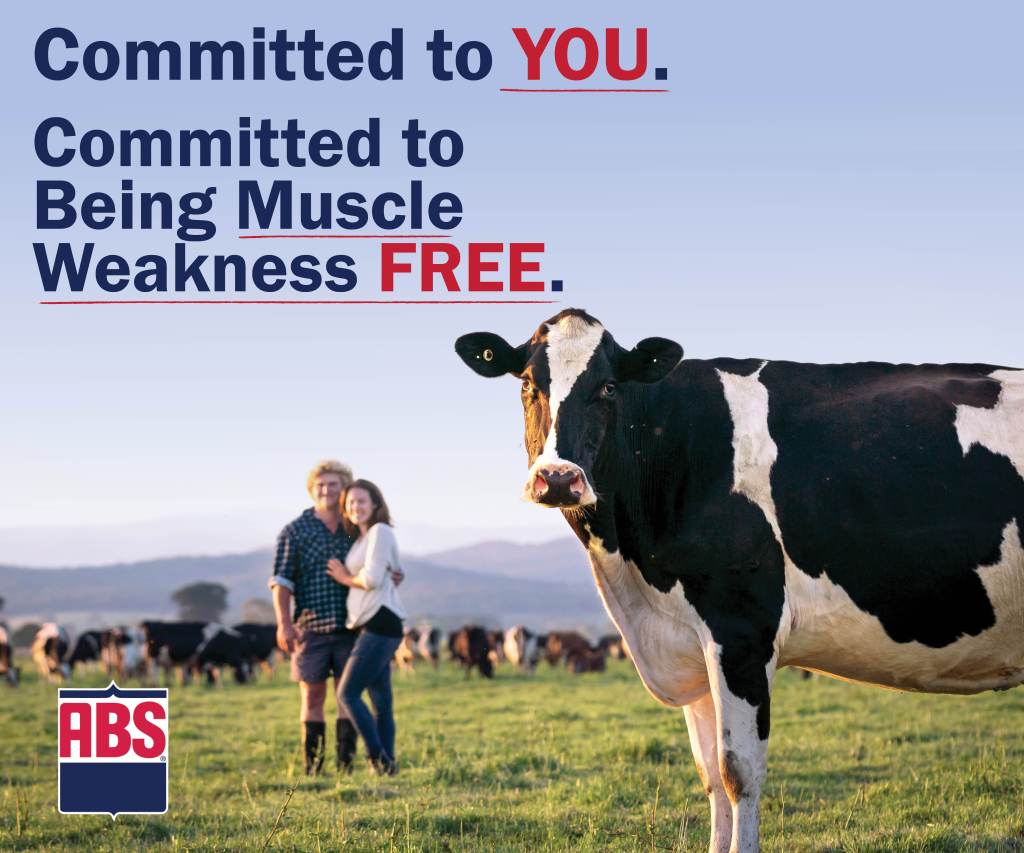
Here at ABS Australia, we have decided to discontinue the marketing and sale of any bulls carrying either the Muscle Weakness haplotype or the JH1 haplotype.
Marcus Rees, General Manager of ABS Australia, states, “Farmers have expressed a need to reduce the potential of breeding animals with Muscle Weakness Syndrome and here at ABS Australia we agree. ABS Australia’s mission is to breed the herds of tomorrow for our dairy farmers and this is an action we can take to immediately reduce the number of animals born with MW next calving and maximise our Jersey customer’s herd’s fertility performance for joining season.”
We make this decision not lightly and with our farmer’s herds, profitability, and offspring in mind. This decision aims to give farmers confidence and ease when making breeding decisions with ABS Australia bulls. With this action, we say goodbye to Muscle Weakness Syndrome and JH1 from the ABS Australia bull team.